

Blog / Relationships
Why Does He Pull Away When You Get Close?
The short answer Why does he pull away when you get close? There is no single reason, and nobody can read his mind from the outside. The usual explanations are stress, a different pace, a habit of withdrawing from closeness, feeling pressured, losing interest, or hot-and-cold behavior. Look at the pattern over several weeks, ask one clear question, and watch what he does afterwards.
Things were going well. Then the messages got shorter, the plans got vaguer, and the closer you felt, the further he seemed to move. If you are asking why he pulls away when you get close, you are probably also asking whether it is your fault, whether he will come back, and what to do in the meantime.
This guide explains six common reasons, what attachment research can and cannot tell you, and how to respond without chasing. We write "he" because that is how most people search, but the same pattern appears in any gender and any kind of relationship. Where we cite research, we say how big the study was and what it cannot tell us.
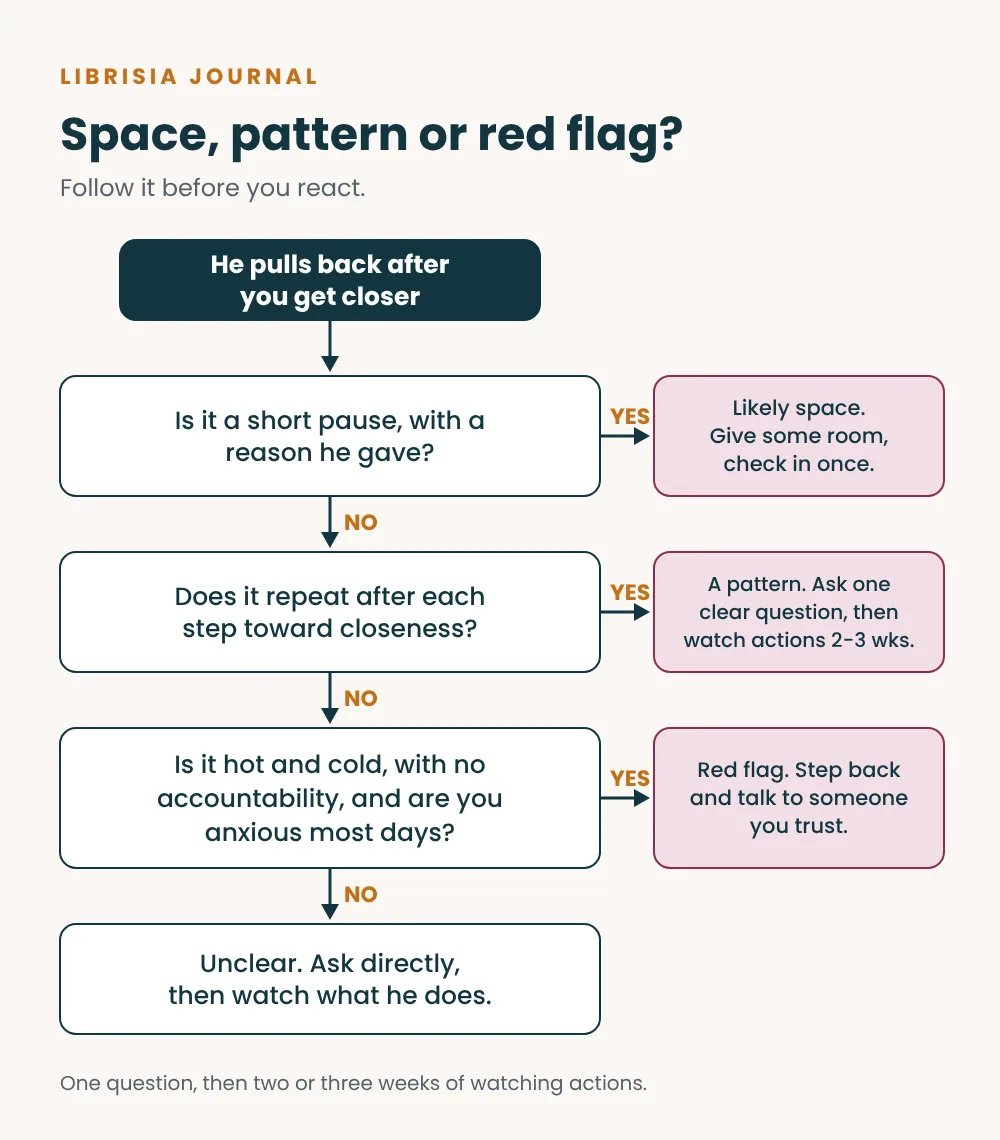
Space, a pattern, or a warning sign?
Not every step back is a problem. A person can pull back for a busy week, a family worry or a bad mood. Three things help you tell the difference.
| Looks like | How to tell |
|---|---|
| Space | It lasts days, has a reason he gave, and he comes back warm and consistent |
| A pattern | It repeats after each step toward closeness, and the same conversation ends the same way |
| A warning sign | It is hot and cold with no accountability, and you feel anxious most of the time |
Keep a short note of what actually happened over a few weeks. Feelings change by the hour, and notes do not.
6 reasons he may pull away
You cannot know which one applies without asking and watching. Use this list to form questions, not conclusions.
| Possible reason | What it can look like |
|---|---|
| 1. Stress or overload | Distance everywhere, not only with you: work, family, health, money |
| 2. A different pace | He backs off when plans, labels or commitment come up, but enjoys the time you spend together |
| 3. A habit of withdrawing from closeness | He pulls back after intimacy or emotional talk, and becomes warm again once the pressure is gone |
| 4. Feeling pressured or criticized | He goes quiet when conversations feel like complaints or tests |
| 5. Losing interest or being unsure | Effort drops across the board, not only after closeness |
| 6. Hot-and-cold behavior | Warm and attentive, then silent, in a cycle, with no explanation when you ask |
More than one can be true at once. A stressed person may also be unsure, and a person who withdraws from closeness may still care a lot.
What attachment research can and cannot tell you
You may have come across the idea of attachment styles. Mikulincer and Shaver (2003) described two kinds of strategies people use when closeness feels threatening or uncertain. Hyperactivating strategies keep a person focused on seeking love and security and alert to signs of abandonment. Deactivating strategies keep the attachment system in check, which affects how openly a person thinks and feels. Put simply, one pattern turns the alarm up, and the other turns it down.
These ideas can help you understand yourself. If your alarm goes off when he pulls back, you may find yourself checking his status, rereading messages or testing him. Fraley and Shaver (2000) reviewed adult romantic attachment theory and listed several open questions, including how best to describe differences between people. It is a useful lens, not a diagnosis. You cannot work out someone's attachment style from the outside, and a label does not tell you what he will do next.
The chase-and-withdraw loop
One pattern is well studied. In the demand-withdraw pattern, one partner presses for change or closeness through requests, complaints or criticism, and the other responds with avoidance or silence. Schrodt, Witt and Shimkowski (2014) combined 74 studies with more than 14,000 participants. As summarized in a press release, couples with this pattern reported lower relationship satisfaction, less intimacy and poorer communication. It was common in both directions, and the authors said that the pattern itself is the problem, not which partner takes which role. These were associations, so the study cannot show that the pattern causes the problems.
The loop is easy to fall into: you reach for closeness, he steps back, you reach harder, he steps back further. You cannot control his half, but you can step out of yours.
7 things to do instead of chasing
You do not need all seven at once. Start with the first two.
1. Write down what actually happened
Make two columns: facts (he did not reply for two days, he cancelled twice) and stories (he is losing interest, he does not care). Act on the first column. Treat the second as questions.
2. Wait before you react
Do not send anything while the alarm is loud. Wait until the next morning to decide, and write the message in your notes first.
3. Do not test or chase
Repeated texts, "are you mad at me?", leaving him on read to see what he does: tests make him feel examined and tell you little about what he feels.
4. Ask one clear question at a calm moment
One subject, one request, not over text during an argument. Use the scripts below.
5. Watch what he does afterwards
Give it two or three weeks. Words are easy. Look at whether he repeats the pattern, follows through on what he said, and tells you when he needs space.
6. Soothe your alarm with something physical
A walk, a shower, a call to a friend, a task with your hands. The goal is not to remove the feeling. It is to wait out the first wave before you decide anything.
7. Decide using patterns, not promises
If he explains, adjusts and follows through, that is a good sign. If the cycle repeats without any change, that is information too.
Word-for-word scripts
Change the details. Keep them short and calm.
| Situation | What to say |
|---|---|
| After a distant week | I noticed we have been less in touch this week. How are you doing? |
| You want clarity | I enjoy spending time with you. I would like to know where you see this going. When can we talk? |
| He says he needs space | Thank you for telling me. How long do you think you need? I will check in on Sunday. |
| He cancels again | That is the second time this month. I would like us to find a plan that works for both of us. |
| You need more contact | I feel more secure when we speak a few times a week. Could we try that? |
| You feel the alarm rising | I am feeling anxious and I do not want to send something I regret. I will write tomorrow. |
| He is warm, then silent, repeatedly | I notice a pattern of closeness and then silence. I need consistency to keep going. Can you offer that? |
Stay, adjust, or step back
| Good signs to keep going | Signs to step back |
|---|---|
| He tells you when he needs space, and comes back when he said he would | The cycle repeats and nothing changes after you talk |
| He listens when you ask for what you need | He dismisses or ridicules your needs |
| Your anxiety is occasional and passes | You are anxious most of the time and shrink yourself to keep him |
| His actions match his words | He is warm only when you pull back or stop asking |
If you find it hard to say what you need, see how to stop being a people pleaser.
Stepping back does not have to be dramatic. It can mean seeing him less, asking for more clarity, or ending things. It is a decision about what you need, not a verdict on whether he is a bad person.
When to get help
Feeling anxious when a partner pulls away is common. These signs are worth bringing to a licensed therapist.
- The same relationship pattern keeps repeating across different partners.
- Your anxiety about being left takes over your days, sleep or work.
- You find it hard to trust anyone, or you keep giving up your needs to avoid losing a partner.
- Your reactions feel linked to past losses or hurt.
A therapist can help you understand your reactions and practice new ones.
Conclusion
You can rarely know why he pulls away when you get close, but you can learn a lot from the pattern over time. Write down the facts, wait before you react, ask one clear question and watch what follows. Step out of the chase, look after your own alarm, and decide based on what he does. Your needs count as much as his, and a good relationship has room for both.
FAQ
Why does he pull away when I get close?
There is no single reason. Common ones are stress, a different pace, a habit of withdrawing from closeness, feeling pressured, losing interest and hot-and-cold behavior. You cannot know which applies without asking and watching what he does over several weeks.
Is it my fault that he pulls away?
Not necessarily. Withdrawing is often about the other person's stress, habits or readiness. You can still look at your own half of the pattern, such as chasing or testing, because that is the part you control.
Should I give him space when he pulls away?
A short, agreed amount of space often helps, especially if he has said he needs it. Tell him you will check in at a set time, and use the time for yourself. Indefinite silence without any explanation is different, and you are allowed to ask for clarity.
How long should I wait for him to come back?
There is no fixed time. Many people use two to three weeks of consistent behavior as a rough guide, and watch what he does, not what he says. If the cycle repeats and nothing changes, that is information.
Does it mean he does not love me?
Not necessarily. A person can care and still withdraw from closeness because of stress, fear or habit. But caring is shown by how someone acts over time. Use patterns, not one-off moments, to judge.
Is it his attachment style?
Possibly, but you cannot diagnose someone from the outside. Attachment research offers a useful lens for understanding patterns, and it is more helpful for understanding your own reactions than for labeling someone else.

Why He Pulls Away When You Get Attached
Calm anxious attachment, soothe the fear of abandonment and love without losing yourself.
Sources
- Mikulincer, M., & Shaver, P. R. (2003). The attachment behavioral system in adulthood: Activation, psychodynamics, and interpersonal processes. Advances in Experimental Social Psychology, 35, 53–152. The attachment behavioral system in adulthood: Activation, psychodynamics, and interpersonal processes
- Fraley, R. C., & Shaver, P. R. (2000). Adult romantic attachment: Theoretical developments, emerging controversies, and unanswered questions. Review of General Psychology, 4(2), 132–154. Adult romantic attachment: Theoretical developments, emerging controversies, and unanswered questions
- Schrodt, P., Witt, P. L., & Shimkowski, J. R. (2014). A meta-analysis of the demand/withdraw pattern of interaction and its associations with individual, relational, and communicative outcomes. Communication Monographs, 81(1). A meta-analysis of the demand/withdraw pattern of interaction and its associations with individual, relational, and communicative outcomes
More from the blog

How Long Does It Take to Get Over a Breakup?
A realistic timeline, what speeds healing up or slows it down, and a 7-day plan for the first week.

How to Stop Thinking About Your Ex: 8 Steps
Why the thoughts keep coming, what makes them worse, and 8 practical steps plus a 10-minute routine for a bad spike.

How to Say No Without Feeling Guilty: 7 Steps
Why refusing feels guilty, 7 steps, word-for-word scripts for work, family and friends, and how to tell guilt that matters from plain discomfort.