

Blog / Relationships
How Long Does It Take to Get Over a Breakup?
The short answer There is no single number. Most people feel the sharpest pain ease within a few weeks to a few months. After a long, intertwined relationship, feeling like yourself again often takes a year or more. If you are on week three and still crying, nothing is wrong with you.
You searched for a number because you want to know when this will stop. That is a fair thing to want. Here is the honest version: researchers have studied breakups for years, and none of them has found a clock that applies to everyone. What they have found is a pattern. It is useful, and it is kinder than most people expect.
A realistic timeline
Grief after a breakup does not fade in a straight line. It comes in waves that start close together and spread out. The picture below shows the typical shape. It is an illustration of the pattern, not a measurement, and your own curve will be different.
Typical pattern, not a deadline. Some people move through it in weeks, others need longer.
Two findings help here. In a 2005 study, Sbarra and Emery followed 58 young adults after a breakup. Feelings of love declined steadily over time, while sadness and anger rose and fell in a curved pattern rather than a straight line. People were also more emotionally volatile than people in intact relationships, especially right after the split. Volatile is the word to remember. Up one day and flattened the next is expected, and it does not mean you are going backward.
The second finding is the good news. In 2008, Eastwick, Finkel, Krishnamurti and Loewenstein tracked people in a longitudinal dating study and compared what they predicted with what they felt. Twenty-six participants broke up during the study. They had forecast their distress two weeks before the breakup, then reported their actual distress afterward. They overestimated how bad it would be, and the gap was biggest for the people who were most in love. It is a small study, and it does not say the pain is mild. It says the pain you imagine at its worst usually passes sooner than you fear.
How long by relationship length
Many articles give a month count for each relationship length. Be careful with those tables, including this one. They are rules of thumb drawn from common experience, not results of a study. Use them to calibrate, not to grade yourself.
| Relationship | When the worst eases | When life feels like yours again |
|---|---|---|
| A few months | 2–6 weeks | 1–3 months |
| 1–3 years | 1–3 months | 4–9 months |
| 3+ years, or lived together | 2–4 months | 9–18 months |
| Marriage or shared children | 3–6 months | 1–2 years, often longer |
Informal ranges, not research findings. Shared homes, money, friends and children stretch everything.
Why it hurts this much
A breakup takes away more than a person. It removes your daily routine, your plans for next year, your shared jokes and the one who knew what your day had been like. It can also shake your sense of who you are.
That last part has been measured. Slotter, Gardner and Finkel (2010) ran three studies and found that self-concept clarity, meaning how sure you are about who you are, drops after a breakup. The drop predicted emotional distress on its own, beyond the other changes in how people described themselves. If you feel lost and not only sad, that is part of the pain, and it is a normal one.
What speeds it up or slows it down
Time matters, but what you do with it matters too. These are the factors most often linked to faster or slower recovery.
| Factor | Tends to slow healing | Tends to help |
|---|---|---|
| Contact with your ex | Texting, checking their profile, “just friends” too soon | Clear distance for a set period |
| Rumination | Replaying the story on a loop, especially at night | Writing it down once, then doing something physical |
| Support | Isolating, hiding how bad it is | One or two people who just listen |
| Daily structure | Empty weekends, irregular sleep | Fixed wake-up time, meals, a short walk |
| Shared life | Same home, shared pet, shared friends | A plan for logistics, handled in writing |
| Who ended it | Being blindsided, no explanation | Some understanding of why, even if it is partial |
Contact is the one you control
In the Sbarra and Emery study, contact with a former partner slowed the decline of both love and sadness. That fits what many people report: every message reopens the wound. If you share a child or a lease, keep contact short, practical and in writing. If you do not, a clean break for a few weeks gives your mind room to settle.
Attachment style plays a role, but it is not a sentence
Marshall, Bejanyan and Ferenczi (2013) surveyed 411 and then 465 people about past breakups. People higher in attachment anxiety reported more breakup distress, and through that distress, more personal growth. People higher in avoidance suppressed their distress and reported less growth. In plain terms, feeling the loss tends to lead somewhere, while pushing it away can leave it waiting. You do not need to wallow. You do need to feel it on purpose, in small doses, instead of dodging it.
Signs you are healing
Progress rarely announces itself. Look for these small shifts instead.
- You went a few hours without thinking about them, and noticed afterward.
- You are sleeping and eating on a roughly normal schedule.
- The waves are shorter or farther apart, even if they still hurt.
- You can hear their name without your stomach dropping.
- You are curious about something again, such as a plan, a show or a trip.
- You can remember the good parts and the bad parts of the relationship in the same breath.
Setbacks do not erase these. A bad week after a good month is part of the curve, not proof that you have failed.
Your first 7 days
The first week is about stability, not insight. You do not have to decide anything yet. Do the small things below and let the rest wait.
Eat something, drink water, and tell one person what happened. Cancel nothing you can cancel later.
Mute, do not block, their accounts if blocking feels too big. Move photos into a folder you will not open this week.
Set a fixed wake-up time and keep it, even if you slept badly. Go outside for ten minutes.
Write for ten minutes without editing: what you miss, what you are angry about. Close the notebook when the timer ends.
Move your body in any way you tolerate. A walk counts. Do it before you check your phone.
See a friend or family member in person, and let it be low effort. A meal, a film, a drive.
List the three hardest moments of the week and what helped each. That list is your own playbook for week two.
If you feel the urge to message them
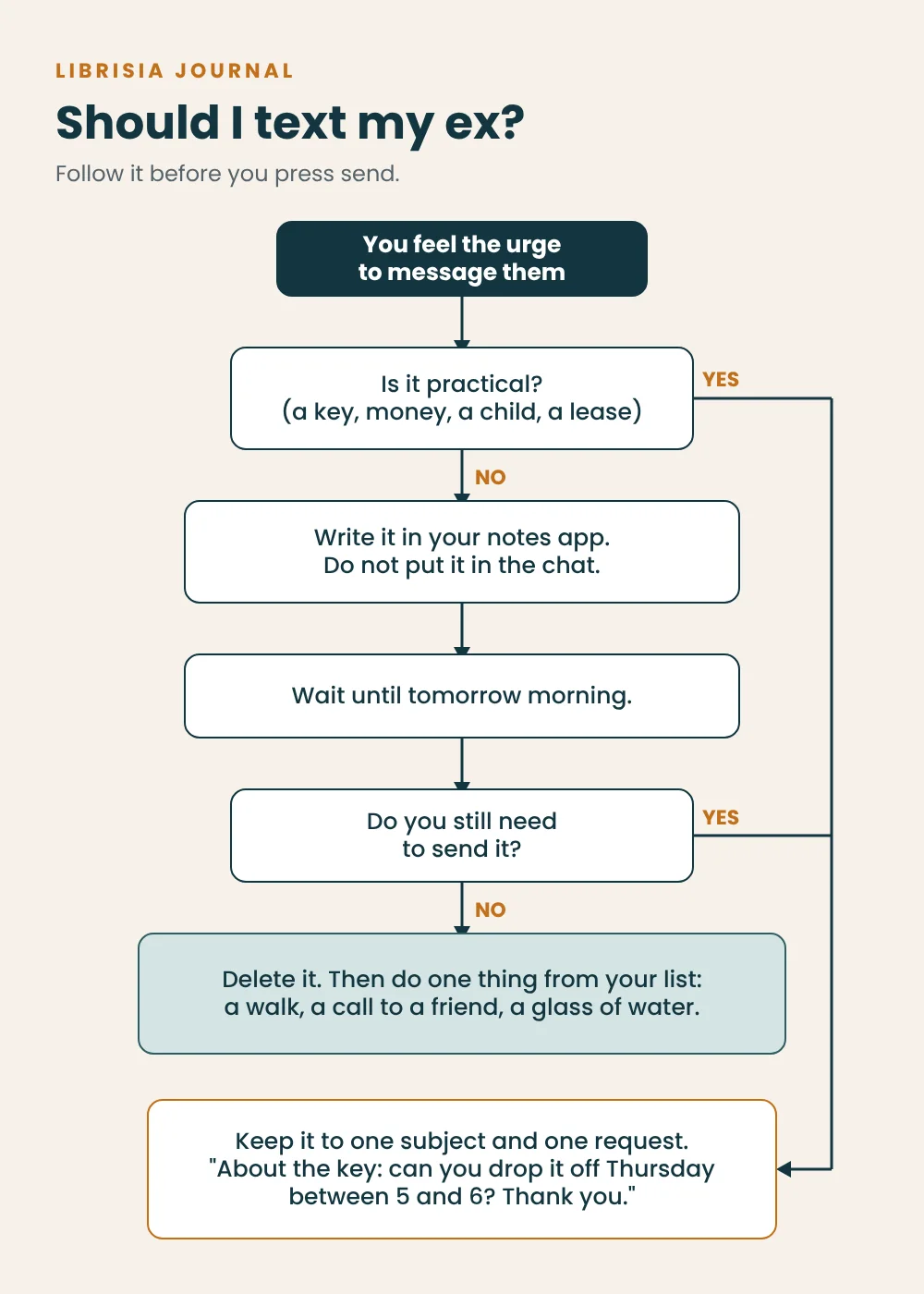
Urges rise and fall. Write the message in your notes app, not in the chat. Wait until the next morning to decide. If you still need to send something practical, keep it to this:
It has one subject, one request and no feelings to answer. That is on purpose.
When to get help
Pain after a breakup is normal. Some signs mean it is time to bring in another person, ideally a doctor or a licensed therapist.
- You cannot eat, sleep or work for weeks.
- You feel hopeless, or numb in a way that is not lifting.
- You are using alcohol or other substances to get through each day.
- You have thoughts of harming yourself or ending your life.
If you are in crisis or in immediate danger, contact your local emergency number right away. You can also call a crisis line in your country. Directories such as findahelpline.com list free, confidential lines by country.
You do not have to be sure it is “bad enough” before you reach out.
FAQ
How long does it take to get over a breakup?
There is no single number. Most people feel the sharpest pain ease within a few weeks to a few months. After a long, intertwined relationship, feeling like yourself again can take a year or more.
Is it normal to still be sad after 6 months?
Yes. Sadness often comes in waves and can return on anniversaries or after reminders. What matters is whether the waves are getting shorter or farther apart, and whether you can function day to day.
Does no contact help you heal faster?
In one study of 58 young adults, contact with a former partner was linked to a slower decline in love and sadness. Cutting or limiting contact, at least for a while, tends to help.
Why does a breakup hurt so much?
A breakup removes a partner, daily routines, shared plans and part of how you see yourself. Research shows self-concept clarity drops after a breakup, and that drop is linked to more distress.
Who gets over a breakup faster, the person who ended it or the one who was left?
Often the person who ended it, but not always. Guilt, doubt and a long shared history can make it hard on both sides.
When should I see a professional about a breakup?
If you cannot eat, sleep or work for weeks, if you feel hopeless, or if you have thoughts of harming yourself, reach out to a doctor or therapist. If you are in crisis, contact your local emergency number or a crisis line in your country.
Moving On
Get through the longing, stop checking on him, rebuild yourself, one day at a time. 7 crisis protocols and 24 word-for-word scripts.
Sources
- Eastwick, P. W., Finkel, E. J., Krishnamurti, T., & Loewenstein, G. (2008). Mispredicting distress following romantic breakup: Revealing the time course of the affective forecasting error. Journal of Experimental Social Psychology, 800–807.
- Sbarra, D. A., & Emery, R. E. (2005). The emotional sequelae of nonmarital relationship dissolution: Analysis of change and intraindividual variability over time. Personal Relationships, 12(2), 213–232.
- Slotter, E. B., Gardner, W. L., & Finkel, E. J. (2010). Who am I without you? The influence of romantic breakup on the self-concept. Personality and Social Psychology Bulletin, 36(2), 147–160.
- Marshall, T. C., Bejanyan, K., & Ferenczi, N. (2013). Attachment styles and personal growth following romantic breakups: The mediating roles of distress, rumination, and tendency to rebound. PLoS ONE, 8(9), e75161.