

Blog / Personal development
How to Stop Being a People Pleaser: 7 Steps
The short answer To stop being a people pleaser, you do not need to care less about people. You need to stop saying yes out of fear. Pause before you answer, start with small low-stakes nos, keep them short and kind, and expect some discomfort for a few weeks. Start with step 1 below.
You say yes before you have thought about it. You agree to the plan, the favor, the extra task, and then you feel tired, annoyed, or both. If you are looking for how to stop being a people pleaser, the goal is not to become cold. It is to make your yes a real choice.
This guide gives you a simple test for telling kindness from fear, seven steps, scripts you can copy, and a four-week plan you can follow slowly. Where we cite research, we say how big the study was and what it cannot tell us.
What people-pleasing is, and is not
People-pleasing means regularly putting other people's wishes ahead of your own because you are afraid of their disappointment, anger or rejection. It is not a medical diagnosis. It is a habit, and habits can change.
It is also not the same as being kind. Helping a friend move house because you want to is kindness. Helping because you cannot bear to say no is something else, even if it looks the same from the outside.
Psychologists describe a related trait called sociotropy: a strong investment in relationships and in other people's approval. In a 2020 study of 279 patients with major depression or generalized anxiety, Martínez Barbosa and colleagues found that brooding, a form of repetitive negative thinking, linked sociotropy to depressive and anxious symptoms. The sample was clinical and the design cannot show cause, so it does not mean people-pleasers are ill. It suggests that the replaying and worrying that often follow a yes or a no matter as much as the trait itself.
Why you do it
There is no single known cause, so be wary of articles that give you a neat origin story. Three things are worth knowing.
Guilt arrives in close relationships
Baumeister, Stillwell and Heatherton (1994) concluded in a review that guilt is strongest and most consistent in close relationships, where people expect to look after each other. If guilt shows up when you refuse someone you love, that is normal. We cover this in how to say no without feeling guilty.
The other person usually sees less cost than you do
Flynn and Lake (2008) ran six studies on direct requests for help. People who were about to ask underestimated by as much as 50 percent the chance that others would agree, and they underappreciated the social cost of refusing. That was a study of requests for help, but it fits a common experience: a request often weighs more on the person answering than on the person asking.
What counts as "too much" depends on culture
Markus and Kitayama (1991) described how cultures differ in how they see the self: some stress independence and expressing your own wishes, others stress being connected and keeping harmony. In many families and communities, attending closely to others is a value, not a flaw. The aim of this guide is not to make you care less about others. It is to make sure you are choosing it.
Helpful or people-pleasing? A quick test
Think of the last three times you said yes. Which column sounds more like you?
| Usually genuine helpfulness | Usually people-pleasing |
|---|---|
| You agreed because you wanted to, or because it matched what you value | You agreed because you could not stand the other person's reaction |
| You could have said no and the relationship would have been fine | You were not sure you were allowed to say no |
| You feel fine or pleased afterwards | You feel resentful, drained or relieved if it is cancelled |
| You gave your honest opinion when asked | You said "I do not mind" when you did mind |
If the right-hand column fits you often, the steps below are for you.
7 steps to stop being a people pleaser
You do not need to do all seven at once. Start with the first two this week.
1. Notice the automatic yes
For one week, only observe. Each time you say yes, ask: "Did I choose that?" You do not need to change anything yet. Many people find their body gives a signal first, like a tight chest or a quick "sure". Learn yours.
2. Put a pause in front of your answer
The simplest change is a delay. Pick one sentence and use it every time:
Then use the time to ask what you would say if you were not afraid.
3. Start with small, low-stakes nos
Do not begin with your mother or your boss. Begin with a shop assistant's upsell, a survey, an invitation you do not want, or "where should we eat?" It is practice, and each one proves that a refusal does not end the world.
4. Keep it short and kind
Use the three parts: a warm sentence, a clear no, and an offer only if you mean it.
More scripts for work, family and friends are in the guide to saying no without guilt.
5. Replace apologies with thanks
People-pleasers often say sorry for existing. Where an apology is not needed, say thank you instead: not "Sorry I am late" but "Thank you for waiting". Keep real apologies for real mistakes.
6. Say one true opinion a day
Choose something small: the restaurant, the film, the time of the meeting. Say it before the other person has said theirs. Honest small opinions make large ones easier later.
7. Write your replies in advance
Gollwitzer and Sheeran (2006) pooled 94 tests of "if-then" plans, such as "If X happens, then I will do Y". On average, people who made such a plan reached their goals more often than those who only had the intention, with a medium-to-large effect (d = 0.65). Plans work best for something you already want to do. Write three: "If someone asks me for a favor on the spot, I will say the pause sentence." "If I feel the urge to apologize, I will say thank you." "If someone pushes back, I will repeat my answer once."
Word-for-word scripts
Change the details. Keep them short.
| Situation | What to say |
|---|---|
| You disagree in a meeting | I see it differently. Can I share my view? |
| Someone asks where to eat | I would prefer the Italian place. |
| You need help | I need help with this. Can you do the first part by Friday? |
| You made a mistake | I made a mistake. Here is how I will fix it. |
| You are doing someone else's work | I cannot keep doing this part. Let us decide who takes it. |
| A friend says "you have changed" | I still care about you. I am also learning to say no when I need to. |
| An invitation you do not want | Thank you for the invite. I cannot make it. Have a great time. |
A 4-week plan, one small step at a time
This is a gentle schedule, not a clinical program. Go slower if you need to.
Notice only. Use the pause sentence three times. Do not refuse anything yet.
Five low-stakes nos or opinions: a shop, a survey, a small invitation, the restaurant.
One medium no with someone you know, such as a coworker favor, and one opinion in a meeting.
One harder no, and one request for help. Then write down what actually happened.
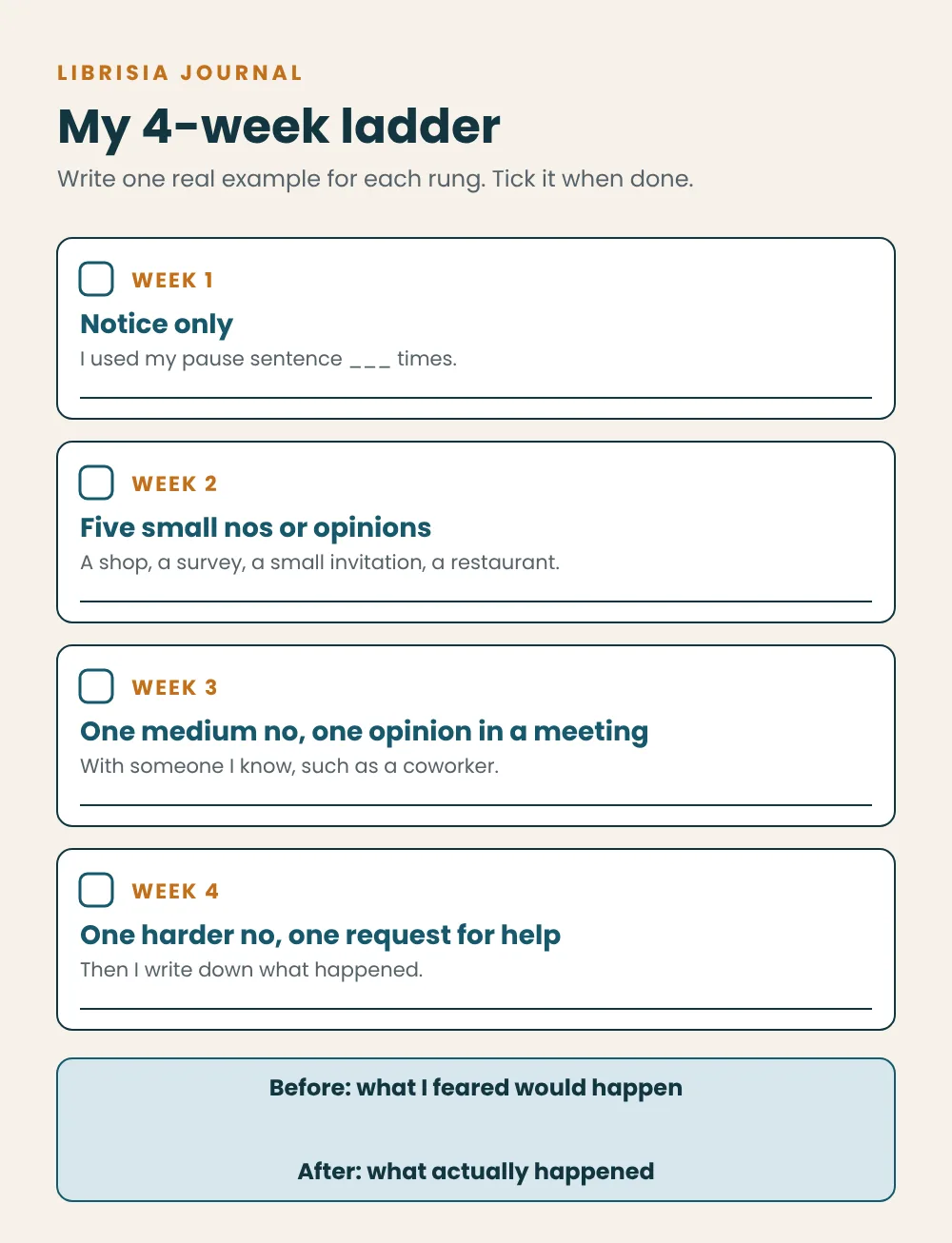
The last part matters. People-pleasing runs on predictions of how bad it will be. Writing down what really happened lets you compare the prediction with the result.
When it goes badly
Some people will be surprised. A few will be annoyed, especially those who benefited from your always saying yes. That does not mean you did something wrong. Stay kind, repeat your answer once, and let the discomfort pass.
You will also have days when you slip back into old habits. That is normal and not a failure. Start again the next day with a small step.
If a relationship only works when you never say no, you may need a longer conversation about it. That is a bigger decision than any script, so take your time.
When to get help
People-pleasing can be worked on alone, but these signs are worth bringing to a licensed therapist.
- You feel intense anxiety or panic at the thought of anyone being displeased with you.
- You cannot make everyday decisions without someone's approval.
- You often feel hopeless, empty or exhausted by trying to keep everyone happy.
- Your pattern is tied to past neglect, abuse or a controlling relationship.
A therapist can help you practice and work on the fears behind the habit.
Conclusion
Learning how to stop being a people pleaser is a matter of small, repeated choices. Notice the automatic yes, put a pause before your answer, practice on low-stakes requests, and keep your no short and kind. The discomfort is real, and it fades with practice. You are not becoming less kind. You are making your kindness a choice.
FAQ
Is people-pleasing a mental illness?
No. It is not a medical diagnosis. It is a pattern of behavior, and it can go along with anxiety or low mood. If it causes you a lot of distress, a licensed therapist can help.
Why am I a people pleaser?
There is no single known cause. Fear of disappointing others, guilt in close relationships and the values of your family or culture can all play a part. You do not need to find the origin before you start changing the habit.
Is being nice the same as people-pleasing?
No. Being nice means choosing to help because you want to. People-pleasing means agreeing because you are afraid of the reaction. The same action can be either, so the question is why you did it.
How do I stop feeling guilty when I say no?
Expect some guilt, especially in close relationships, and do not treat it as an order. Ask whether it points to something you can repair, or only to discomfort. The guide on how to say no without feeling guilty explains how.
How long does it take to stop being a people pleaser?
There is no fixed time. Many people notice it becomes easier within a few weeks of regular small practice, but changing a long habit takes longer, and some days will be harder than others.
Will I lose friends if I stop people-pleasing?
Some people may react badly at first, especially those who benefited from your always saying yes. Most good relationships adjust. If one only works when you never say no, that is worth knowing.
Saying No Without Guilt
Set your boundaries, calm anxious attachment and stop pleasing everyone.
Sources
- Martínez Barbosa, R., Senra, C., Fernández-Rey, J., & Merino, H. (2020). Sociotropy, autonomy and emotional symptoms in patients with major depression or generalized anxiety: The mediating role of rumination and immature defenses. International Journal of Environmental Research and Public Health, 17(16). Sociotropy, autonomy and emotional symptoms in patients with major depression or generalized anxiety: The mediating role of rumination and immature defenses
- Baumeister, R. F., Stillwell, A. M., & Heatherton, T. F. (1994). Guilt: An interpersonal approach. Psychological Bulletin, 115(2), 243–267. Guilt: An interpersonal approach
- Flynn, F. J., & Lake, V. K. B. (2008). If you need help, just ask: Underestimating compliance with direct requests for help. Journal of Personality and Social Psychology, 95(1), 128–143. If you need help, just ask: Underestimating compliance with direct requests for help
- Markus, H. R., & Kitayama, S. (1991). Culture and the self: Implications for cognition, emotion, and motivation. Psychological Review, 98(2), 224–253. Culture and the self: Implications for cognition, emotion, and motivation
- Gollwitzer, P. M., & Sheeran, P. (2006). Implementation intentions and goal achievement: A meta-analysis of effects and processes. Advances in Experimental Social Psychology, 38, 69–119. Implementation intentions and goal achievement: A meta-analysis of effects and processes
More from the blog

How Long Does It Take to Get Over a Breakup?
A realistic timeline, what speeds healing up or slows it down, and a 7-day plan for the first week.

How to Stop Thinking About Your Ex: 8 Steps
Why the thoughts keep coming, what makes them worse, and 8 practical steps plus a 10-minute routine for a bad spike.

How to Say No Without Feeling Guilty: 7 Steps
Why refusing feels guilty, 7 steps, word-for-word scripts for work, family and friends, and how to tell guilt that matters from plain discomfort.