

Blog / Personal development
How to Say No Without Feeling Guilty: 7 Steps
The short answer To say no without feeling guilty, decide your answer before you speak, keep the no short and kind, and do not over-explain. Guilt will often show up anyway for a while. It is not proof that you did something wrong. Start with step 1: do not answer on the spot.
You know how to say the word. The hard part is the hour afterwards, when you replay the conversation, picture their face and think about writing back to take it all back.
This guide shows how to say no without feeling guilty, or at least how to feel less of it and not act on it. It includes scripts you can copy, answers to push-back, and a way to tell guilt that points to a real problem from guilt that is just discomfort. Where we cite research, we say how big the study was and what it cannot tell us.
Why saying no feels guilty
Guilt is a social feeling. In a 1994 review in Psychological Bulletin, Baumeister, Stillwell and Heatherton concluded that guilt arises from interpersonal situations and is strongest, most common and most consistent in close relationships, where people expect to care for each other. The same review argues that guilt can serve those relationships, by pushing people to treat their partners well.
That helps explain why it is hardest to say no to family, a partner, close friends and a boss you like. It does not mean the no was wrong. It often means the relationship matters to you.
A second reason is that the person asking usually does not see how hard it is to refuse. Flynn and Lake (2008) ran six studies on direct requests for help. In the first three, people who were about to ask underestimated by as much as 50 percent the chance that others would agree. In the last study, they found that people making a request were less willing than people receiving one to appreciate the social costs of saying no. The study was about asking for help, not about every kind of request. But it fits what many people report: the request often weighs more on you than on the person who made it.
What does not work
Over-explaining
A long reason gives the other person a long list of things to fix. If you say "I cannot because of the deadline", they may answer "then I will wait until Friday". A short no leaves less to negotiate.
The vague maybe
"Let me see" or "I will try" feels kinder in the moment. It adds a second decision, a second conversation and usually a second round of guilt when you finally refuse.
The invented excuse
A made-up reason can work once. It then needs to be remembered, repeated and defended. You are also adding a lie to a situation that only needed a no.
Saying yes, then cancelling
This is the most common route for people who find it hard to refuse. It feels easier at the time and costs more later, for you and for the other person.
7 steps to say no without feeling guilty
You do not need to use all seven every time. For a small request, steps 1, 3 and 4 are enough.
1. Do not answer on the spot
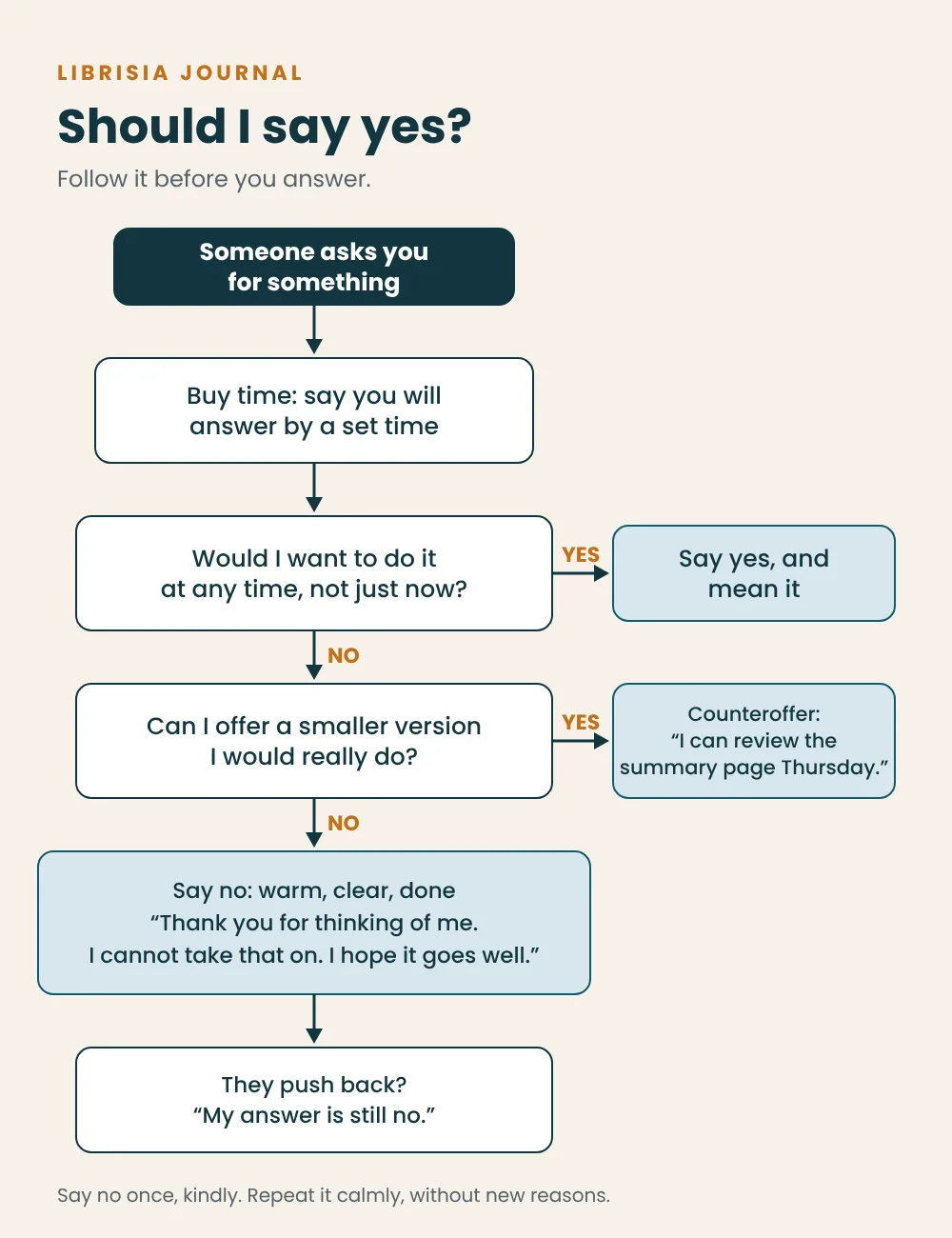
Most "yes" answers that you regret are given in the first five seconds. Buy time with a sentence that is true and neutral.
Then keep the deadline you gave.
2. Decide your answer before you find the words
Ask three questions on paper or in your notes: What would I have to give up to say yes (sleep, money, a weekend, a task)? What happens if I say no? Would I say yes if the request were for next month instead of now? If the answer is "I would not want to do it at any time", you have your answer.
3. Use a short formula: warm, clear, done
Three parts: one warm sentence, one clear no, and an offer only if you really mean it.
The word "cannot" is clearer than "I do not think I can" or "I am not sure I should".
4. Give one reason, or none
A reason is optional. If you give one, make it true, short and about you, not about them: "I am at my limit this week". Do not add a second reason.
5. Offer an alternative only if it is real
A smaller version, a later date or a name of someone else can soften a refusal, but only if you would be happy to do it. Otherwise you are saying yes in two steps.
6. Write your reply in advance
Gollwitzer and Sheeran (2006) combined 94 tests of "if-then" plans, such as "If X happens, then I will do Y". On average, people who made such a plan reached their goals more often than people who only had the intention, with a medium-to-large effect (d = 0.65). Plans work best for something you already want to do, and they cannot give you the wish. Here, the plan is simple: pick the three requests you get most often and write one reply for each.
A small 2012 study by Patrick and Hagtvedt gives a hint about wording. In a 10-day study of 30 women trying to resist a temptation, those told to say "I don't do X" reported feeling more in control than those told to say "I can't do X". It was small, self-reported and about temptation, not about declining people, so use it only as an idea. A policy you actually have ("I do not lend money") can make a refusal feel less personal. Do not invent a policy that you do not follow.
7. Plan what you will do with the guilt
Expect it for the first minutes or hours, especially if you rarely say no. Do not use it as an order. Put the message away, do something physical for ten minutes, and ask the question in the section "Is your guilt a signal or just discomfort?" below before you decide to change your answer.
Word-for-word scripts
Change the names and details. Keep them short.
| Situation | What to say |
|---|---|
| A friend asks for a favor you cannot do | I would love to help, but I cannot this time. I hope it goes well, and tell me how it turns out. |
| A coworker asks for extra work | I cannot take that on this week. I can look at it next Tuesday if it is still open. |
| Your manager adds a task | I can do that. To do it well, I would need to move the report to next week. Which one should come first? |
| A family member asks for a long visit | We cannot do the whole weekend. We can come for Saturday lunch. |
| Your partner asks for something you do not want | I do not want to do that. I want you to know it is not about you. Can we talk about what you need? |
| Someone asks to borrow money | I do not lend money. I hope you find a solution. |
| An invitation in a group chat | Thank you for the invite. I cannot make it. Have a great time. |
When they push back
A first no is rarely the end of the conversation. Decide beforehand how you will repeat it.
Repeat it, calmly
Do not argue the reason
If you start defending the reason, you have reopened the decision. Say "I have decided" and move to another topic.
When it becomes a guilt trip
If the person is above you
With a boss or a client, a flat no is often not the best choice. Name the cost of saying yes and ask them to choose: "If I take this on, X will move. Do you want that?" This is a refusal that keeps the relationship.
If refusing has a real price
Sometimes saying no costs something: a tense week with family, a difficult talk at work. You can accept the cost and still say no, or you can say a partial yes. Decide with open eyes, and do not tell yourself that a good no should have no cost.
If someone threatens you, punishes you or makes you afraid when you refuse, this is no longer a question of guilt. Your safety comes first. Tell someone you trust and see the help box below.
Is your guilt a signal or just discomfort?
Guilt can mean "you did harm" or only "this is unfamiliar". Ask yourself the question below, on paper.
| Usually just discomfort | Worth a second look |
|---|---|
| You refused something that was not your job | You said you would do it and did not, without telling anyone |
| You were clear and polite | You were unkind, or said something you wish you could take back |
| The other person is disappointed but has other options | Someone who depends on you is left without help, and you could have warned them |
| The feeling fades within hours or a day | The feeling is about a specific thing you can name and repair |
If the right-hand column fits, the fix is not to take back the no. It is to repair the part that was unkind or late: a short message, an apology for the tone, or earlier notice next time.
When to get help
Finding it hard to say no is common and can be worked on. These signs are worth bringing to a licensed therapist or doctor.
- You cannot refuse anyone, and it is hurting your health, sleep or work.
- You feel intense fear, panic or shame at the thought of disappointing someone.
- You say yes mostly because you are afraid of how a particular person will react.
- Your habit of pleasing others is linked to past abuse or neglect.
A therapist can help you practice saying no and work through the fear behind it.
Conclusion
Learning to say no without feeling guilty is mostly practice. Decide before you speak, keep the no short and kind, and have a reply ready for push-back. The guilt may still show up for a while. Ask whether it points to something you can repair or is only discomfort, and give it time to pass. Each small no makes the next one easier. If saying yes is a wider habit, read how to stop being a people pleaser.
FAQ
Why do I feel so guilty when I say no?
Guilt is a social emotion, and research on it suggests it is strongest in close relationships where people expect to look after each other. Feeling guilty often means you care about the person. It does not prove that you did something wrong.
How do I say no politely?
Use three parts: a warm sentence, a clear no and an optional alternative you really mean. For example: "Thank you for thinking of me. I cannot take that on. I hope it goes well." Avoid "maybe" and "I will try".
Do I have to give a reason when I say no?
No. A reason is optional. If you give one, keep it true and short, and give only one. A long explanation gives the other person more to argue with.
How do I say no to my boss?
A flat no is often risky. Name what would have to move if you say yes, and ask which priority comes first: "I can do that. To do it well, I would need to move the report to next week. Which one should come first?"
How long does the guilt last?
For most people it fades within hours or a few days, and more quickly the more often you practice. If it stays strong for weeks, or you cannot refuse anything, it may help to talk to a therapist.
Is it selfish to say no?
Not by itself. Everyone has a limited amount of time and energy, and saying yes to one thing means saying no to something else. It becomes a problem only if you refuse to help in ways that harm others when you could easily have helped, which is rarely what people who feel guilty about saying no are doing.

Saying No Without Guilt
Set your boundaries, calm anxious attachment and stop pleasing everyone.
Sources
- Baumeister, R. F., Stillwell, A. M., & Heatherton, T. F. (1994). Guilt: An interpersonal approach. Psychological Bulletin, 115(2), 243–267. Guilt: An interpersonal approach
- Flynn, F. J., & Lake, V. K. B. (2008). If you need help, just ask: Underestimating compliance with direct requests for help. Journal of Personality and Social Psychology, 95(1), 128–143. If you need help, just ask: Underestimating compliance with direct requests for help
- Gollwitzer, P. M., & Sheeran, P. (2006). Implementation intentions and goal achievement: A meta-analysis of effects and processes. Advances in Experimental Social Psychology, 38, 69–119. Implementation intentions and goal achievement: A meta-analysis of effects and processes
- Patrick, V. M., & Hagtvedt, H. (2012). "I don't" versus "I can't": When empowered refusal motivates goal-directed behavior. Journal of Consumer Research, 39(2), 371–381. "I don't" versus "I can't": When empowered refusal motivates goal-directed behavior
More from the blog

How Long Does It Take to Get Over a Breakup?
A realistic timeline, what speeds healing up or slows it down, and a 7-day plan for the first week.

How to Stop Thinking About Your Ex: 8 Steps
Why the thoughts keep coming, what makes them worse, and 8 practical steps plus a 10-minute routine for a bad spike.

How to Stop Being a People Pleaser: 7 Steps
Tell kindness from fear with a quick test, then follow 7 steps, copy-ready scripts and a gentle 4-week plan.