

Blog / Relationships
How to Stop Thinking About Your Ex: 8 Steps
The short answer To stop thinking about your ex, you usually cannot rely on willpower. What helps is to stop feeding them, give them a fixed place and time, and give your mind something specific to do instead. Expect the thoughts to get shorter and less frequent over weeks. If they are taking over your days, start with steps 1 and 3 below.
If you want to stop thinking about your ex, the goal is smaller than forgetting them. You are trying to get through an hour, an evening, a night, without your mind going back to them for the hundredth time. That is a more realistic goal.
This guide explains why the thoughts keep coming, what makes them worse, and what you can do today. Where a claim comes from a study, we say which one, how big it was and what it cannot tell us.
Why you cannot stop thinking about your ex
Right after a breakup, constant thinking is not a flaw in you. It is what a mind does when something important has been taken away.
In 2010, Helen Fisher and colleagues scanned the brains of 15 college-age adults who had recently been rejected by a partner and were still intensely in love. On average 63 days had passed, and all of them said they spent more than 85 percent of their waking hours thinking about that person. When they looked at a photo of their former partner, areas linked to reward and craving were more active than when they looked at a photo of a neutral person. So were areas linked to physical pain and distress. The authors suggested that romantic rejection may be a specific form of addiction. That is a hypothesis from a small group. It does not mean your brain is damaged, but it explains why the pull can feel physical, and why one look at a photo can restart everything.
The same study found that the longer it had been since the rejection, the less activity there was in a region linked to attachment. In that group, the pull weakened with time.
Two habits keep the loop going.
Rumination
Rumination means thinking over and over about your feelings and problems without getting anywhere. A 2008 review by Nolen-Hoeksema, Wisco and Lyubomirsky concluded that it exacerbates depression, enhances negative thinking, impairs problem solving and erodes social support. Replaying the last conversation feels like working on the problem. It usually is not.
Checking
In a 2012 survey of 464 people, Marshall found that those who checked a former partner's Facebook page reported more distress about the breakup, more negative emotion and more longing, and less personal growth. The pattern held after accounting for offline contact, personality and features of the relationship. It is a survey, so it cannot prove which causes which: people in more pain may also check more. But checking gives the loop new material every time.
What does not work
Most advice on how to stop thinking about your ex starts with "just stay busy" or "do not think about it". Here is why those fall short.
Forcing the thought away
In the 1987 "white bear" experiments, Wegner and colleagues asked people to talk for five minutes while trying not to think of a white bear. They could not fully manage it. When they were later told they could think about the bear, those who had tried to suppress it had significantly more bear thoughts than those who had been allowed to think about it from the start. In a second experiment, people who were given a specific distracter thought to use during suppression had less rebound afterwards. This was a lab task with a neutral thought, not a breakup, so treat it as a hint. It points to two things: pushing a thought down tends to keep it close, and a ready-made replacement helps.
Hunting for the answer to "why"
Why did they leave, did they ever love me, what if I had said something else. These questions feel urgent, and none of them can be settled by thinking harder. The mind keeps searching because it has not found an answer, so it never closes the case.
One last look
A glance at their profile, a reread of old messages, a drive past their street. Each one resets the clock.
8 things that help you stop thinking about your ex
You do not need all eight. Start with the first three and add the others as you go.
1. Take away what feeds the loop
Do an audit of the places where you meet them. Mute or archive their accounts, even if you cannot bring yourself to block them. Move their photos into one folder you will not open this month. Take their chat out of your home screen and notifications. Mute the playlist that goes with them. If friends pass on news, ask them once:
2. Name it when it starts
When the thought arrives, say to yourself: "That is the loop again." It takes ten seconds. You are not arguing with the thought or pushing it away. You are noticing it, so you are less likely to follow it for the next forty minutes.
3. Give the thoughts an appointment
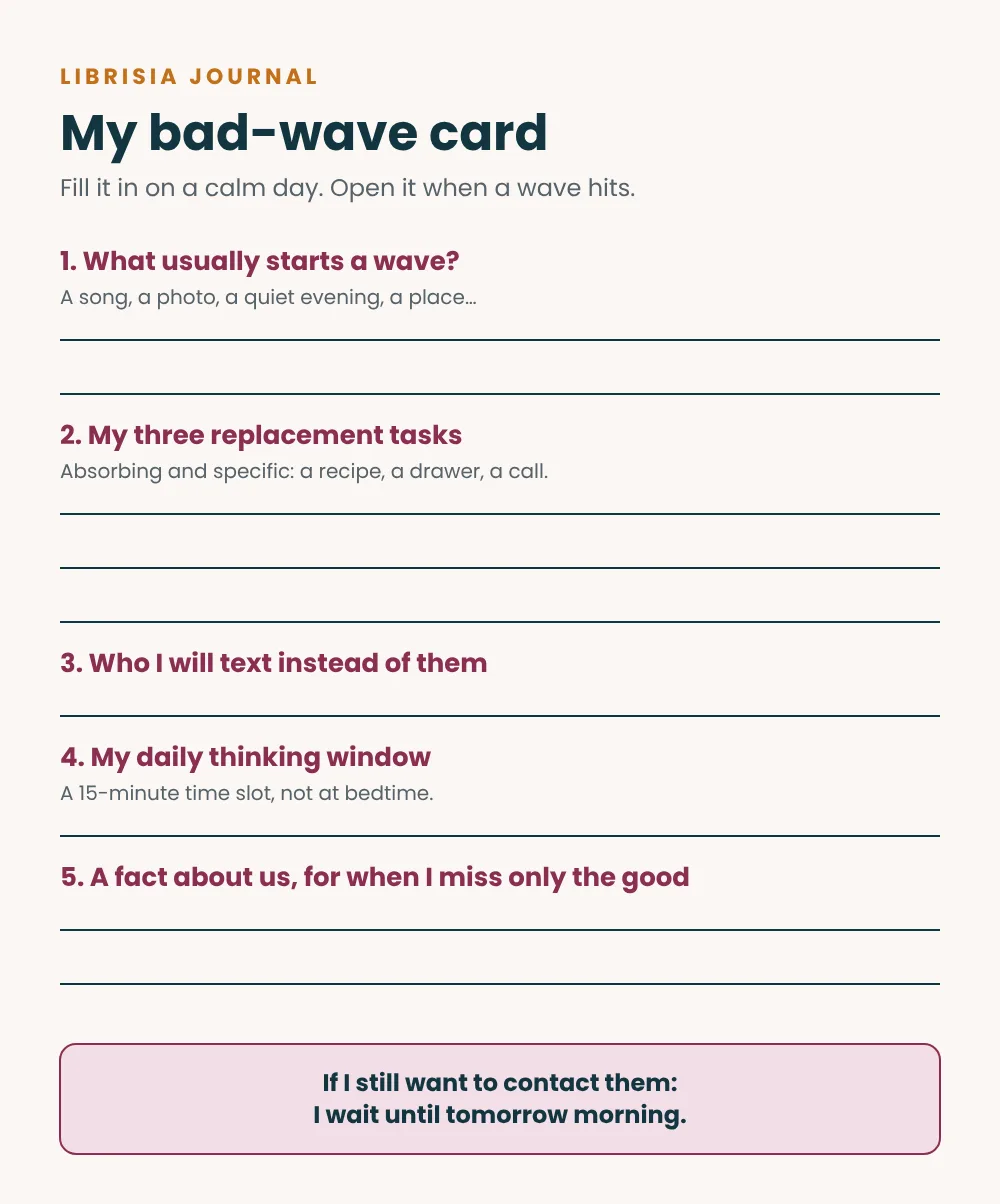
Pick a 15-minute window each day, not at bedtime. Set a timer and think about them on purpose, on paper if you can. When a thought comes up at another time, write one word on a note and tell it: "Tonight at six." When the timer ends, stand up and do something physical. This is a technique from clinical practice for worry and rumination. We are not citing a study for it here, and it works best if you keep the window short and keep it every day.
4. Ask "what do I need now?" instead of "why?"
Ayduk and Kross (2010) studied what happens when people look back at painful experiences from a distance, as a "fly on the wall", instead of from inside the memory. In their studies of students and of couples, people who did this more showed less emotional reactivity and fewer intrusive thoughts later. Most of their material was not about breakups, so take it as a method to try, not a promise.
To try it, write five sentences about this evening in the third person and with your own name: "Sam is on the sofa, thinking about the night it ended. Sam is tired and has not eaten. What does Sam need in the next hour?" Then do that one thing.
5. Pick your replacement ahead of time
The distracter in Wegner's second experiment was a specific thought, not a vague instruction to think about something else. Do the same. Choose two or three absorbing tasks in advance: a recipe you have to follow, a ten-minute tidy of one drawer, an episode you have never seen, a call to a friend. Write them on a note. When a spike comes, you pick one. You do not have to invent it while you are upset.
6. Write the facts, and put the questions aside
Take one page and draw a line down the middle. On the left, write facts about the relationship, the good and the difficult, as you would tell them to a stranger. On the right, write the questions nobody can answer today: "Do they miss me?", "Are they seeing someone?", "Was it my fault?" Look at the left side when you feel the pull to idealize them. Leave the right side alone.
7. Rebuild a small routine
Fixed wake-up time, one real meal, ten minutes outside, one contact with a person each day. A day with a shape leaves fewer open gaps for the loop. For a longer version, see the 7-day plan in How long does it take to get over a breakup.
8. Plan the contact you cannot avoid
If you share children, a lease, a workplace or a friend group, do not leave it to the moment. Keep each message to one subject and one request, in writing, at a time you chose.
At work, a greeting and the work topic are enough. After the meeting, take a short walk before you do anything else.
A 10-minute routine for a bad spike
For the moments when a wave hits and the urge to look, call or write is strong.
Say it: "This is a wave." Waves rise and fall. You do not have to decide anything now.
Put your phone face down in another room, or turn off the screen. Sit or stand somewhere new.
Slow your breathing, with a longer breath out than in, for two minutes.
Write one line: what happened just before the wave? A song, a photo, a quiet hour?
Start the replacement task you chose in step 5. Ten minutes is enough.
Any decision to contact them waits until tomorrow morning.
How long will this last?
There is no date. In Fisher's group, the pull toward the former partner was weaker in people for whom more time had passed. For ranges and what changes them, see How long does it take to get over a breakup. A realistic goal for the first weeks is not zero thoughts. It is shorter waves, farther apart, that you can get through without checking.
When to get help
Thinking about an ex is normal. These patterns are worth bringing to a doctor or a licensed therapist, who can teach you tools for thoughts that loop.
| Usually part of healing | Worth getting help |
|---|---|
| Thoughts come in waves, often at night or after a reminder | Thoughts fill most of your day for weeks without easing |
| You can still work, eat and sleep on most days | You cannot work, eat or sleep for weeks |
| The waves are getting shorter or farther apart | You feel hopeless, or numb in a way that is not lifting |
| You feel sad, angry or lonely, and it moves | You use alcohol or other substances to get through each day |
Conclusion
You will probably not stop the thoughts by force. What works is smaller: give the loop less to feed on, give the thoughts a time and a place, and have a replacement task ready for the bad waves. Expect the waves to get shorter and farther apart over weeks, not to disappear overnight. If nothing eases after several weeks, talk to a doctor or a therapist.
FAQ
Is it normal to think about my ex all the time?
Yes, especially in the first weeks. In a small brain-imaging study of people recently rejected in love, all 15 said they spent more than 85 percent of their waking hours thinking about their former partner. What matters is whether the thoughts are getting shorter or less frequent over time, and whether you can still function.
How long will I keep thinking about my ex?
There is no fixed date. Many people notice the thoughts coming less often over weeks to months, and a long relationship can take longer. If you are stuck for weeks with no change, talk to a professional.
Does thinking about my ex mean I am not over them?
Not necessarily. A thought can appear because of a song or a place, and then pass. It is a bigger sign when you keep feeding it by checking their profile or rereading messages, because that gives the thoughts new material.
Should I let myself think about them?
Fighting the thought tends to keep it close. A short daily window to think about them on purpose, on paper, gives the thoughts a place so they take up less of the rest of your day.
Why do I think about my ex more at night?
At night there is less to occupy your mind, so thoughts and feelings that were in the background move to the front. A fixed evening routine and a plan for what to do when a wave hits can help.
Does no contact help me stop thinking about them?
Reducing what you see of them, including their social media, is one of the most direct ways to give the thoughts less to feed on. In a survey of 464 people, checking an ex's Facebook page was linked to more distress and longing. It cannot prove cause, but it fits what many people report.

Moving On
Get through the longing, stop checking on him, rebuild yourself, one day at a time. 7 crisis protocols and 24 word-for-word scripts.
Sources
- Fisher, H. E., Brown, L. L., Aron, A., Strong, G., & Mashek, D. (2010). Reward, addiction, and emotion regulation systems associated with rejection in love. Journal of Neurophysiology. Reward, addiction, and emotion regulation systems associated with rejection in love
- Nolen-Hoeksema, S., Wisco, B. E., & Lyubomirsky, S. (2008). Rethinking rumination. Perspectives on Psychological Science, 3(5), 400–424. Rethinking rumination
- Marshall, T. C. (2012). Facebook surveillance of former romantic partners: Associations with postbreakup recovery and personal growth. Cyberpsychology, Behavior, and Social Networking, 15(10), 521–526. Facebook surveillance of former romantic partners: Associations with postbreakup recovery and personal growth
- Wegner, D. M., Schneider, D. J., Carter, S. R., & White, T. L. (1987). Paradoxical effects of thought suppression. Journal of Personality and Social Psychology, 53(1), 5–13. Paradoxical effects of thought suppression
- Ayduk, Ö., & Kross, E. (2010). From a distance: Implications of spontaneous self-distancing for adaptive self-reflection. Journal of Personality and Social Psychology, 98(5), 809–829. From a distance: Implications of spontaneous self-distancing for adaptive self-reflection
More from the blog

How Long Does It Take to Get Over a Breakup?
A realistic timeline, what speeds healing up or slows it down, and a 7-day plan for the first week.

How to Say No Without Feeling Guilty: 7 Steps
Why refusing feels guilty, 7 steps, word-for-word scripts for work, family and friends, and how to tell guilt that matters from plain discomfort.

How to Stop Being a People Pleaser: 7 Steps
Tell kindness from fear with a quick test, then follow 7 steps, copy-ready scripts and a gentle 4-week plan.